
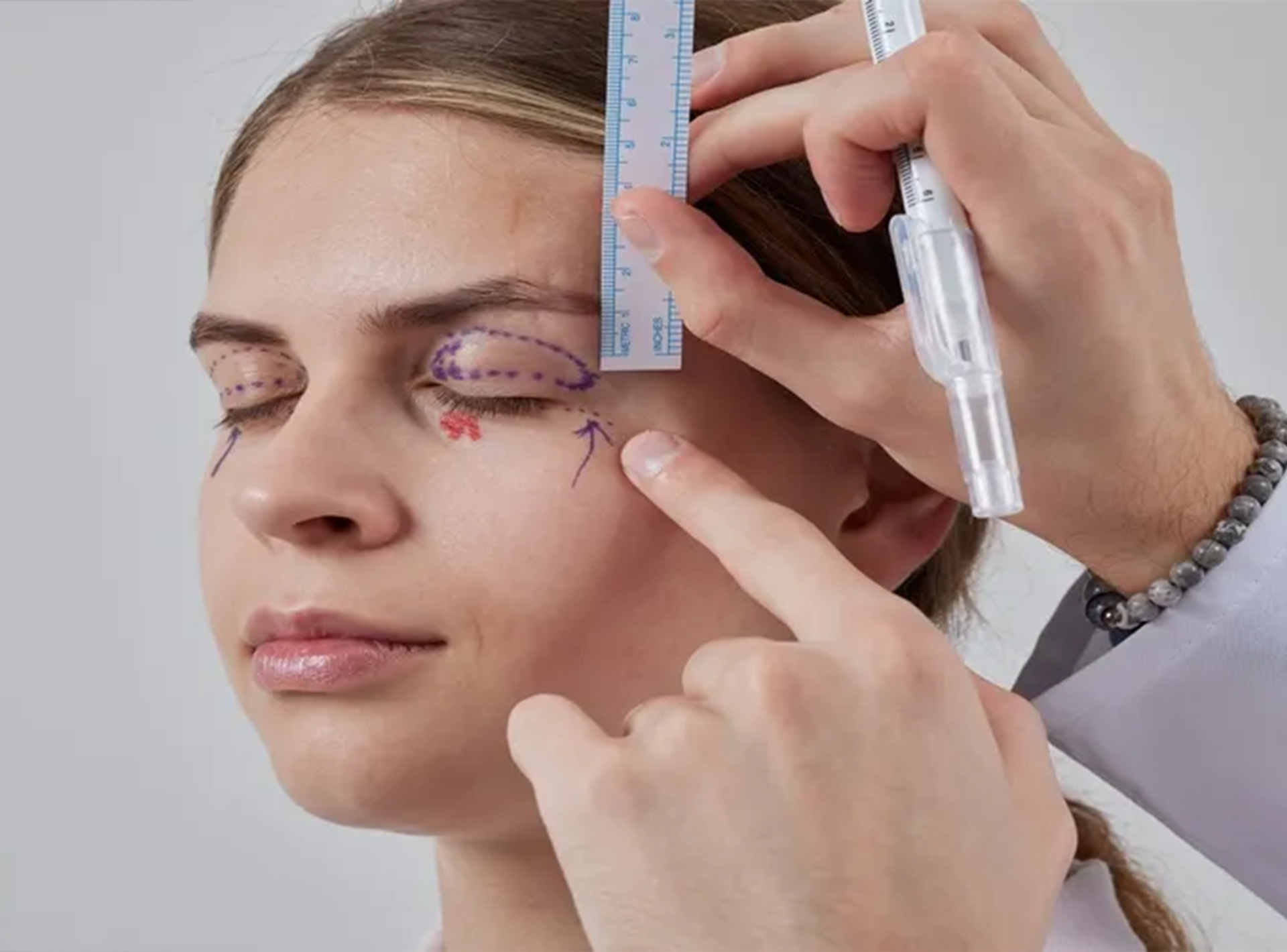
A rested, younger look around the eyes
Over time the upper eyelids develop sagging, puffiness and excess skin. This affects not only appearance; in some people it also narrows the field of vision. Upper eyelid surgery (upper blepharoplasty) rejuvenates the eye area both functionally and aesthetically and brings life back to the eyes.
What is upper eyelid surgery?
Upper blepharoplasty removes excess skin, reduces puffiness and reshapes the muscle of the upper eyelid. The aim is a fresh, rested look while keeping your natural expression. With this operation:
- Sagging of the upper eyelids is corrected,
- Puffiness above the eye is reduced,
- Small yellowish deposits on the eyelid (xanthelasma) can be removed at the same time.
Why the brow position matters
A low brow can make the upper eyelid look heavier than it really is. In some patients the problem is solved with a brow lift alone. That is why I always assess the forehead, brow and eyelid together before planning the operation.
Botox and heavy eyelids
Botox can lift the tail of the brow slightly and reduce heaviness on the outer part of the eyelid, but it is usually not enough for excess skin on the inner part. In people with heavy eyelids, Botox applied with a standard technique can drop the brow further, so the injection plan has to be individual.
The operation
- Consultation and planning. I assess the eyelid structure, brow position and amount of excess skin. If needed, the operation is planned together with a brow lift or lower eyelid surgery.
- Surgery. Performed under local anaesthesia and takes about 45 minutes; you go home the same day. Excess skin and fat are removed and the muscle is tightened. The incision sits in the natural eyelid crease, so the scar is not noticeable.
- Closure. The incision is closed with fine sutures and light protective strips are applied for 3 days.
Recovery
- First 3 days: mild swelling, bruising and tightness are normal.
- After day 5: swelling around the eyes reduces considerably.
- Day 7: stitches are removed.
- Days 7 to 10: return to social life.
For patients travelling from abroad, a stay of about one week in Istanbul is usually recommended.
Possible risks
Blepharoplasty performed with the right technique is a very safe operation. Rarely, the following may occur:
- Mild asymmetry
- Temporary bruising or swelling
- Temporary dry eye
- Very rarely, difficulty closing the eye if too much tissue is removed
These risks are minimised with an experienced surgeon and careful planning.
Before surgery
- Blood thinners (aspirin, warfarin, ibuprofen, etc.) should be stopped one week before.
- Vitamins, herbal supplements and alcohol should be stopped.
- Please tell us about any chronic condition (thyroid disease, diabetes, high blood pressure, glaucoma, etc.).
Frequently asked questions
Where and how is the operation performed?
If it is done on its own, I perform it in my own clinic under local anaesthesia. We add sedation if needed. If it is planned together with a facelift or another operation, I do it in hospital under sedation or general anaesthesia.
How long does it take, and can I go home the same day?
It takes about 45 minutes. You can go home straight after the operation.
Will there be a scar?
I place the incision inside the natural crease of your eyelid, so it isn’t visible when your eyes are open. I don’t use dissolvable sutures on the upper eyelid, because they can cause a reaction in that thin, delicate skin. I use non-dissolvable sutures and we remove them on day 7.
When can I go back to social life?
The stitches come out on day 7 and then you’re back to your social life. Most of my patients are back at work and their daily routine within 7 to 10 days.
Will the shape of my eyes change?
No. I only remove the excess skin and, if needed, fat. I don’t change the natural shape of the eye. The goal isn’t a different eye, it’s a rested look.